
What Great Scientists Know That LLMs Don’t
 by Khalil Kaddoura, Optagon Labs

A few weeks ago, I met the founder of an AI lab who told me that after they solved code, they now wanted to turn to science and solve it too. If you spend enough time in Silicon Valley’s frontier AI circles, you will hear statements like this every day. Having spent thousands of hours in chemistry and biology labs myself, I find much of today's dialogue around AI for science deeply unreasonable and misleading. This has made me increasingly invested in finding definitions for the concepts of autonomous science and scientific superintelligence.
In this essay, I briefly explore the nature of science and the ways in which AI might accelerate scientific progress within the current boundaries of the technology. I also attempt to predict what would need to be achieved for machine intelligence to reach scientific superintelligence, and whether this is possible at all.
One misconception I frequently see is the assumption that AI for science must follow the same trajectory as previous waves of technology. Humans have designed workflows to carry out certain activities, and new technologies have emerged to make those workflows more efficient. I believe this paradigm will be fundamentally different. Scientific superintelligence will mean much more than simply accelerating the methods we already use.
The intelligence machine will not be bound by methods invented by humans, especially when those methods were developed around the constraints of human intelligence. Machines will ultimately create entirely new ways of doing science, built around their increasing capabilities. This is an essential pre-requisite to scientific superintelligence.
Before we attempt to define the concept of scientific superintelligence, and understand what it entails, we must first understand the nature of science itself: a form of inquiry built upon two systems, theory and practice.
1. The First System of Science: Theory
Theory is where you abstract general principles about the world that did not exist before.
This means being the first to say that space and time are interconnected, that children inherit traits because of units called genes, or that Earth is round. If a concept was not known before, and you lay out a theory that you validate, that’s a discovery that leads to a general abstraction, possibly treated as ground truth until proven otherwise.
Theory is different from brute-force search.
Brute-force search is when you spin up hundreds of thousands of design-space searchers, ask them a question, and let them search for a solution. Brute-force search doesn’t necessarily result in the invention of new general principles; it’s actually built on previously discovered ground truths.
Today, theory remains the property and product of human ingenuity. Perhaps our ability to come up with theories is derived from our fascinating ability to generalize and learn from very few observations. I will illustrate this with an example.
Louis Pasteur: Challenging a Scientific Paradigm
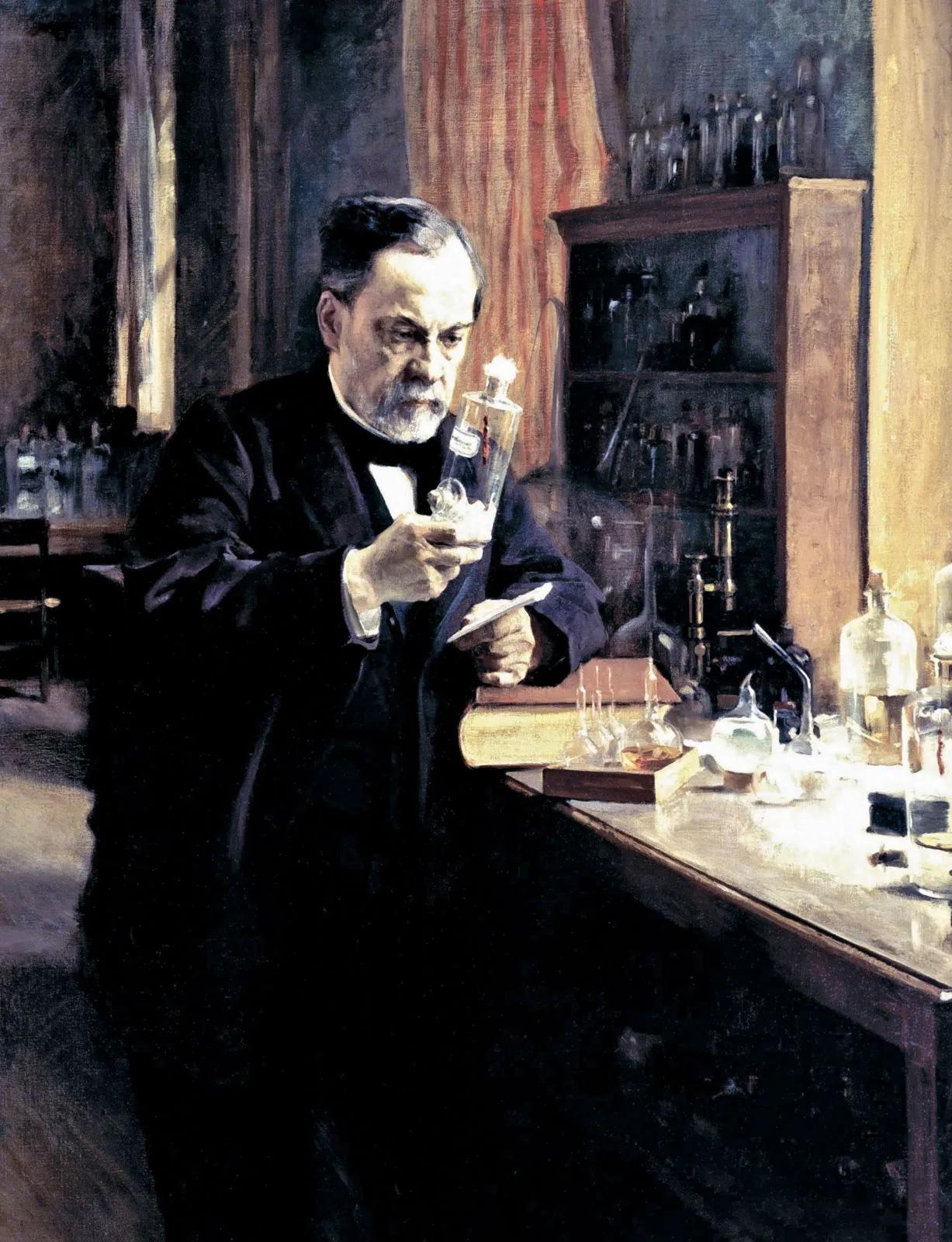
In the 1800s, when people asked why milk was spoiling, the prevailing scientific paradigm said that there was a chemical reaction going on.
But then a brilliant scientist called Louis Pasteur said, “It could actually be biology.”
So how did he reach that conclusion? Well, he boiled milk, and after he boiled it, it didn’t spoil. And he thought, wait, what if there are living organisms inside the milk that die when the milk is boiled?
With this observation, Pasteur challenged an entire scientific paradigm that said milk was spoiling and grapes were turning into wine because of chemistry.
Now, what would brute-force search have done here? What if Pasteur had an LLM swarm and asked it, “Why is milk spoiling?”
It would spin up solvers and search within the known rules of chemistry. It would never try to challenge the status quo, but would look at different types of milk, different weather conditions, different flasks, and interpolate within the rules of known chemistry.
Today, it sounds intuitive to us that milk spoils because of microbes, but imagine the courage it took Pasteur to challenge the status quo.
Imagine right now challenging Pasteur and saying, “No, it’s not biology.” LLM swarms will never go this far. Many of these theories are contrarian, and you don’t reach them through brute-force search.
And so brute-force search is what OpenAI did when it solved Navier–Stokes and when it reportedly found the enzyme. And people need to know this. The distinction between discovering new principles and searching within existing ones is important when we talk about the future of scientific intelligence.
This is not to say that brute-force search is not useful. There are definitely problems where it’s the right solution, like recursive self-improvement in AI research or solving many problems like the ones listed above. It is only inaccurate to say that the LLM scaling paradigm will lead to novel discoveries, and anyone who says this must first understand what novel discovery really means.
2. The Second System of Science: Practice
Practice is when you make perturbations in a system, record the signal, and use that signal to validate or invalidate a hypothesis. Now, you could either do this with trial and error brute-force search, or you can simply find the right experiment to do, which will make hundreds of thousands of experiments unnecessary. Pasteur provides another fascinating example of this.
Pasteur’s Experiment
After Pasteur laid out his theory, he wanted to know whether the microorganisms were coming from the milk itself or from the environment. To do this, he designed a flask.
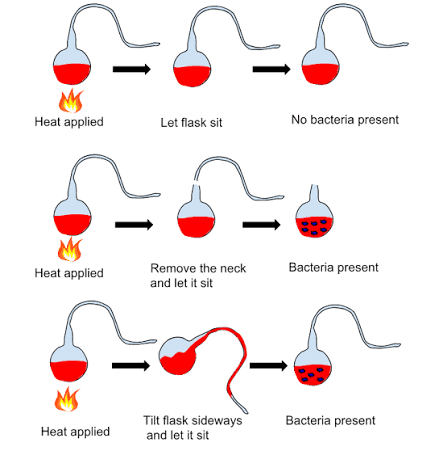
He first sterilized this flask, and he hypothesised that bacteria would get stuck at the bottom of the elbow. He thought, if I put the milk in the flask, the bacteria would enter from the atmosphere, get stuck here, and not enter the milk.
And so indeed, the bacteria got stuck and the milk was sterile. He tilted the flask, then adjusted it again, and the milk was spoiled.
Now, what would brute-force search have done?
It would have designed a million flasks, tested thousands of environmental conditions, and different types of milk from different cows.
Maybe it would find a flask that stops the milk from spoiling, but would it understand that the bacteria got stuck in the elbow and that’s why the milk was sterile? It would most likely infer that the shape of the flask or the type of the milk was responsible for the outcome.
Now remember that we’re talking about a very old experiment. Today’s experiments are much more complicated versions of this. Looking backward, we take a lot of those things for granted and we assume that we know those things, but at that time, experiments like this were really hard to conduct and think about.
Why Novelty Matters in Practice
Scaling models for science is not the same as scaling code or text. The reason why extraordinary capability was accrued in the latter is because training data was abundant and verification was fast. Language and code follow their own rules of logic, which were implicitly learned, to a useful extent, through scaling. Science offers neither. You can’t do a trillion experiments to create a dataset, and you can’t wait months for each experiment.
So you need to do just the right experiment that teaches you the most, and there’s a lot of novelty and ingenuity in this. When it comes to science, the most important question is not simply how many experiments a system can perform, but how much it can learn from each experiment.
3. When Would AI Truly Reach Scientific Intelligence?
For AI to qualify as scientific superintelligence, it must go beyond replicating human scientific capabilities on the two avenues of science that today remain property of human ingenuity. This raises two fundamental questions about the nature of scientific intelligence:
On theory: Can machine intelligence discover and abstract new general principles from very few observations?
On practice: Can it design experiments that maximize learning and reduce uncertainty, finding the shortest path to an answer? And can it draw the right conclusions from those experiments?
To me, these are the two questions that should be central to any conversation about autonomous science and scientific superintelligence.
They are also the questions we hope to explore, challenge, and eventually help answer.